Thursday, 28 August 2014

Technology covergence may save your life


Elsie Wausi has been caught three times by traffic police either texting or talking on her phone.

Each has been a different experience that she never wants to go through again. It included either parting with money and wasting productive hours at the crowded courts. For her the hefty price saw her quickly adapt new habits, especially when on the road.

Using a mobile phone while driving has been shown to have a number of detrimental effects on driving behaviour
She no longer drives without her LG Tone Infinim headset, which allows her to connect to her LG smartphone when on the road, using Bluetooth. The headset allows Ms Wausi to operate her smartphone hands free including sending and receiving calls as well as dictating messages. “I do have to say this has simplified my life, and it connects efficiently to my devices and boasts high quality sound,” she said.

A report by the World Health Organisation on the growing problem of diver distraction by Mobile Phones Use stated the using of hands-free phone devices while driving has slowly lead to reduced visual monitoring of the car and general traffic situation thus reducing the probability of causing an accident.

“Using a mobile phone while driving has been shown to have a number of detrimental effects on driving behaviour. Drivers are not only physically distracted by phoning and driving simultaneously, but they are also cognitively distracted by having to divide their attention between the conversation they are involved in and tasks relating to driving,” the report says.

The report advocates for the use of hands free devices and governments putting in place policies to reduce road carnage due to distraction caused by being on the phone.

For Ms Wausi the hands free headset has allowed the business woman, who runs her cake business out of her home kitchen and delivers to clients, to get a lot of work done, with ease, as she sits in traffic.

She no longer limits the use of her headset to the car and can be found carrying on a conversation comfortably as she pours cake mix into a baking tin. With the handset in place she is able to continue working as she talks to her clients taking orders which she later dictates to her message board.

Today people are more interconnected than ever before and technology is at the forefront of this. The market offers a wide range of connectivity devices allowing for intelligent devices to ‘talk’ to each other. This is quickly changing people’s day-to-day lives allowing them to save on time, energy and to an extent how they consume the different available products.

Wearable technology is also gaining popularity with people embracing the devices to better ease their lives. One such technology is the Android Wear smart watches. The Samsung Galaxy Gear, Sony and LG’s G Watch are some of the recent accessories which allow one to pair, seamlessly, with other android devices.

These accessories run on the same technology but boast different features including overall design and memory. The LG G Watch device runs on any android device running on 4.3 or greater, while the Samsung Galaxy Gear pairs with Samsung device through NFC and Bluetooth.

These devices make it easier to sync with a wide range of products ranging from smartphones to tablets in the market easing the customers’ lives.They use voice command and give users more options to interact with their devices, helping users to stay connected always.

Thursday, 31 July 2014

LG leaps ahead of rivals with “chatting” appliances


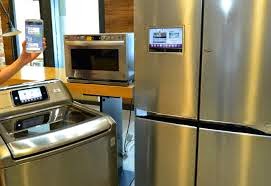
With the Innovative HomeChat™ service, you can now “instruct” and receive updates from your fridge, microwave or washing machine

One would think only a significant leap into the future would yield smart appliances that “chat.” LG Electronics seems to have leaped light years into the future and recently announced the launch of appliances with revolutionary HomeChat™ messaging service in South Korea.

A model displays an LG smartphones during the unveiling of LG smart applainces
The interactive new feature employs Natural Language Processing (NLP) and LINE, the popular mobile messenger app with over 300 million users, to let homeowners communicate, control, monitor and share content with LG’s latest smart appliances.

This is not the first time the electronic manufacturer is attempting to stretch the limits in enhancing the interactivity of its products with end users, the development of the Werniche Project has seen LG make quick progress in incorporating voice commands. Known as VoiceMate, LG's voice recognition technology has only recently entered the international stage.

Electronics manufacturers have for some time been toying with voice commands to make consumer's lives easier. Siri, the voice-activated personal assistant built into the iPhone, was at one time the most prominent example of a mobile voice interface. But voice functionality is built into Android, the Windows Phone platform, and most other mobile systems, as well as many apps.

Voice-command interfaces are now almost pervasive in most electronic devices, from mobile phones, TVs, even automobiles. The concept of holding a conversation with a computer seemed pure science fiction until recently. “Our unyielding quest is to make our smart appliances sophisticated,” says Josep Kim, the LG East Africa Managing Director.

LGs premium smart appliance lineup includes a camera-equipped refrigerator, a washing machine that allows users to start and download washing cycles remotely via HomeChat™ and a Lightwave oven that supports NFC and WiFi for convenient control from any location.

LG HomeChat™ incorporates the popular LINE application to allow users to receive recommendations and control settings when away from home. “With an intuitive interface, HomeChat™ makes communicating with LG’s smart refrigerator, washing machine or oven much like chatting with a close friend,” says Mr Kim.  

For extra convenience, the Quick Button feature enables fast and easy access to each appliance’s most commonly used functions. HomeChat™ also gives users the choice of three different modes: Vacation, Away and Return-home. LG’s new service even brings an element of fun to appliances, offering a selection of over 40 unique LINE stickers to add an enjoyable, personal component to conversations.

“Today’s intelligent home appliances offer a variety of useful functions but many consumers still find setting them up an extremely complicated process.” said Seong-jin Jo, president and CEO of the LG Electronics Home Appliance Company. “Not only does LG HomeChat help simplify and enhance our products, they also deliver a unique user experience, adding even more value to our customers’ lives.”

The smart refrigerator incorporates several breakthrough innovations, such as the Smart View feature. Using the industry’s first built-in internal refrigerator camera positioned at the top of the main compartment, users can monitor exactly what’s inside their refrigerator on their smartphones or tablets.

The Smart Manager’s Freshness Tracker makes it possible to input a wide range of foods and beverages to keep track of expiration dates. The fridge also has a unique Health Manager can make recipe recommendations as well as daily and weekly meal plans based on the user’s personal profile. Age, sex, weight and height information are used to determine body mass index (BMI), which is then used to create an appropriate, personalized meal plan.

This is a clear indicator the pace of technological advancement and increasing sophistication. A growing number of people now talk to their mobile smart phones, asking them to send e-mail and text messages, search for directions, or find information on the Web.

In addition the new wave of interconnected smart appliances such as the Smart Refrigerator and HOM-BOT also have built-in smart technology which are able to be operated via voice commands or programmed remotely allowing users who cannot physically operate these devices to effectively engage with the technology.

Voice-command interfaces are now almost pervasive in most electronic devices, from mobile phones, TVs, even automobiles. The concept of holding a conversation with an appliance seemed pure science fiction, not anymore. 

Monday, 21 July 2014

LG G3 guns for top position ahead of Samsung’s release of Galaxy Note 4


Newly launched LG G3
With LG Electronics having launched its most anticipated smartphone and Samsung on the verge of unveiling the Samsung Galaxy Noted 4 in September this year, this is an apt time to juxtaposition the two gadgets.    

The comparison is critical considering that the two devices will be among the most popular smartphones of 2014. The leaks have kept us guessing and most of the information on the Samsung Galaxy Note 4 is not officially verifiable, however for readers interested in buying the LG G3 or waiting for the release of Samsung Galaxy Note 4.

The the term G3 easily conjures a picture of a light automatic weapon; the legendary NATO battle rifle developed by the German armament manufacturer Heckler & Koc at the tail end of World War II. However, LG Electronics did not have the ravages of mortal combat in mind when it recently released the acclaimed G3 Smartphone.

Conversely, the electronics manufacturer says its aim was to make life simpler and smarter.  The new gadget shoots—pictures—better than the G3 riffle. The speed demon boasts of 13MP OIS+ (Optical Image Stabilizer Plus) camera with a revolutionary Laser Auto Focus that can shoot stunningly sharp images in a fraction of the time required by conventional phone cameras.

But the G3 is not one trick pony, Josep Kim, the LG East Africa Managing Director says the G3 is the phone that will remind you to carry an umbrella for a rainy day and give you a part on your shoulder for accomplishing a scheduled task. As pundits await the release of the Samsung Galaxy Note 4, here’s a sneak preview of what we know.       

Display
The LG G3 has a 5.5 inches IPS LCD Display with a superior resolution of 1,440 x 2,560 pixels. Whereas the Samsung Galaxy Note 4 is expected to come with a relatively bigger 5.7 inches display, with the same resolution as the LG G3. It is worth noting that, the predecessor Galaxy Note 3 featured only a 1,920 x 1,080 pixels resolution, and hence it is a huge improvement but still doesn’t match the LG G3.
Obviously the display will be a deciding factor for many, simply because of the sheer size and stunning resolutions we’ll be receiving. The LG G3 is the first smartphone to arrive in the U.S. with a 2560 x 1440 Quad HD display (some call it a 2k display) and it looks gorgeous. Samsung didn’t deliver it with the S5 like many expected, and instead all rumors are pointing to a new Galaxy F (Prime) and the Galaxy Note 4 to offer a Quad-HD display from Samsung.

Hardware, Software and Internal Storage          
The LG G3 is powered by a quad-core Krait 400 (Qualcomm Snapdragon 801) processor, clocked at 2.5 GHz and it comes with a 2 GB of RAM (if opted for 16 GB of storage) and a 3 GB of RAM (If opted for 32 GB of storage). Also, the LG G3 comes with 16 GB or 32 GB of internal storage with microSD card slot for expansion up to 128 GB.
The Galaxy Note 4, on the other hand, will reportedly be powered by either an octa-core processor on Exynos 64-bit chipset or a big.LITTLE 16-core processor on Exynos 64-bit chipset. The Note 4 will house a whopping 4 GB of RAM and up to 128 GB of internal storage.
The Samsung Galaxy Note 4 will reportedly be running on the upcoming Android v4.5 Lollipop out-of-the-box, while the recently released LG G3 runs on the latest Android v4.4.2 KitKat OS.

Camera and Battery
The LG G3 comes with a 13 MP rear-facing camera with dual-LED (dual tone) flash and a 2.1 MP front-facing camera. The Galaxy Note 4, on the other hand, is expected to house a whopping 20.7 MP rear-facing camera and a 5 MP front-facing camera. Last year the previous version was one of the first Android devices with Optical Image Stabilization, and the new LG G3 continues that with OIS+ technology. The LG G3 comes equipped with a 13 megapixel OIS+ camera with a laser-auto focus similar to what we see on high end professional DSLR cameras.
In addition, the LG G3 can shoot 4K (3,840 x 2,160) videos. The killer camera features of LG G3 include 'Laser Autofocus Sensor' and 'Selfie' Mode. LG claims that the laser autofocus sensor functionality is very quick as it takes only 0.276 seconds to focus. Additionally, the camera also features simultaneous video and image recording and voice activation.
The LG G3 houses a solid user-replaceable 3000 mAh battery, whereas the Galaxy Note 4 is expected to house a relatively better 3600 mAh battery unit.

Design
The design of the Galaxy Note 4 is largely up in the air. Most are assuming it will be similar to the Galaxy Note 3 and Galaxy S5 in terms of overall design cues, but we’ll have to wait and see. Samsung’s been toying with metal on a Galaxy S5 Prime, so we could see an aluminum Galaxy Note 4. At the same time that likely won’t be the case if the device comes with a curved display as we mentioned above.
Samsung’s built a following using the same design on almost all devices, and we doubt it will be changing, even if the materials do. Expect a large 5.7-inch Galaxy Note 4 with a camera and flash in the middle, a dedicated home button that should house a fingerprint scanner for addition LG on the other hand, is pushing the boundaries and changing things up. Just like the LG G2 the G3 will be one of the smallest devices that offers such a large screen. The slim bezels around the 5.5-inch display make the device roughly the same size as the Galaxy S5. Meaning the screen is barely smaller than the Note 4 will offer, yet the devices physical size will likely be much smaller. Something many will consider when it comes to portability.
The next major design factor is the rear-facing buttons. The power and volume controls are around back, rather than the sides and nicely fit where an index finger rests for most users holding a device. It was popular with the G2, and is a feature many will enjoy once the LG G3 gets released.

LG G3 Specs
  • 5.5-inch 2560 × 1440 Quad-HD display
  • 2.5 GHz Quad-core Snapdragon 801 with 2/3GB of RAM
  • 13 Megapixel camera with OIS+, laser auto-focus, 2.1-megapixel front camera
  • 16GB storage and microSD card slot with up to 128GB support (32GB model available)
  • Android 4.4.2 KitKat
  • 3,000 mAh battery with wireless charging
  • WiFi, Bluetooth, NFC, 4G LTE, FM Radio, IR Remote
  • DLNA and Miracast support
  • Metallic Black, Silk White, Gold Shine, Moon Violet, and Burgundy Red color options
  • 146.3 x 74.6 x 9.1mm
Galaxy Note 4 Specs
  • 5.7-inch 2560 x 1440 Quad-HD display
  • 2.5 GHz Quad-core Snapdragon 805 with 3GB of RAM
  • 16 Megapixel OIS camera, 2.1 front shooter
  • 16GB storage and micro-SD slot with 128GB support
  • Android 4.4.3 KitKat
  • 3,500 mAh battery
  • WiFi, Bluetooth, NFC, 4G LTE, FM, IR Remote
  • S-Pen stylus for content creation
  • Fingerprint scanner for security
  • Possible curved AMOLED display option
  • Black & White color variants at launch

Friday, 11 July 2014

World Cup fans win Jambojet goodies


Jambojet Sponsored live viewing of the quarter finals football action that was between France Vs Germany/Brasil Vs Columbia on 4th July and Argentina Vs Belgium/Nerthalands vs Costa Rica on the 5th July in Kisumu Barcadia Lounge. Fans who did get the right predictions won return air tickets from Kisumu to Nairobi courtesy of Jambojet and branded merchandise and Jersey’s from the different teams.